


Long Distance Microwave (MW) Link
Introduction
A Long Distance Microwave (MW) Link is a point-to-point wireless communication system that transmits high-speed digital information between two geographically separated locations using microwave radio frequencies. Instead of relying on physical transmission media such as copper cables or fiber-optic cables, microwave links use highly directional radio waves that travel through free space. These systems have become an essential part of modern telecommunications infrastructure, supporting mobile networks, internet service providers, utility companies, government agencies, and enterprise networks.
Long-distance microwave links are particularly valuable in areas where installing fiber-optic cables is technically difficult, economically impractical, or environmentally challenging. Mountainous terrain, deserts, forests, rivers, islands, and remote rural regions often make fiber deployment expensive and time-consuming. In such situations, microwave communication provides a reliable and cost-effective alternative for transporting voice, video, and data traffic.
Main Purpose of a Long Distance Microwave Link
The primary objective of a microwave link is to establish reliable communication between Site A and Site B over long distances while maintaining high network availability and low latency.
Its major purposes include:
- Connecting two remote telecommunications sites.
- Carrying voice, data, video, and internet traffic.
- Providing backhaul transmission between cellular base stations and the core network.
- Extending communication services to remote locations.
- Serving as an alternative or backup to fiber-optic infrastructure.
- Supporting emergency communication when wired links fail.
- Delivering high-capacity transmission with minimal installation time.
Modern microwave systems can support capacities ranging from a few megabits per second to several gigabits per second, depending on the equipment, modulation scheme, and channel bandwidth.
Diagram Description
A typical long-distance microwave link consists of two communication sites connected by a highly directional wireless radio path.
The diagram generally includes:
- Telecom Tower at Site A
- Microwave Dish Antenna at Site A
- Microwave Radio Equipment
- Indoor Equipment Cabinet
- Router and Local Area Network (LAN)
- Free-space microwave transmission path
- Microwave Dish Antenna at Site B
- Microwave Radio Equipment
- Indoor Equipment Cabinet
- Network Switch
- LAN or downstream network
The microwave signal travels through the atmosphere over a direct line-of-sight path, typically covering a distance of approximately 50 km, although longer distances are possible under suitable conditions.
Site A Components
Telecom Tower
The telecom tower provides the necessary elevation for the microwave antenna.
Increasing antenna height helps maintain clear line-of-sight communication by avoiding obstacles such as buildings, hills, trees, and other structures.
Tower heights vary depending on terrain but commonly range between 30 and 100 meters.
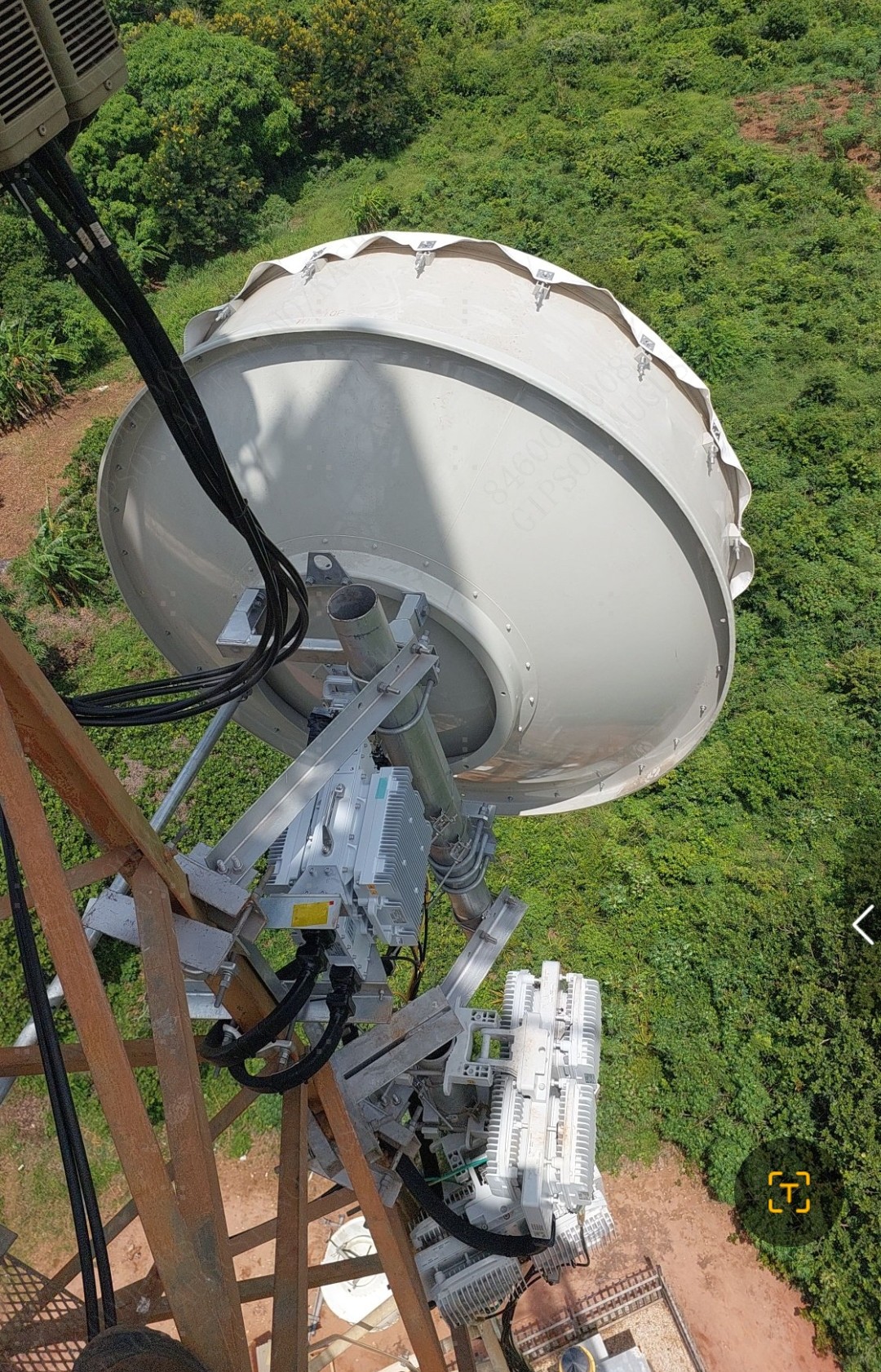
Microwave Antenna
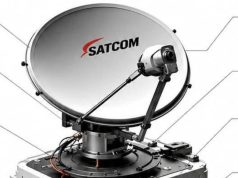
The microwave antenna is usually a highly directional parabolic dish.
Its functions include:
- Transmitting microwave signals toward the remote site.
- Receiving microwave signals from the opposite terminal.
- Concentrating RF energy into a narrow beam.
- Reducing interference from unwanted directions.
Dish antenna diameters commonly range from 0.3 meters to 3.7 meters depending on frequency and required link performance.
Microwave Radio
The microwave radio converts digital Ethernet or TDM traffic into microwave radio frequency signals.
Its major functions include:
- Signal modulation.
- Frequency conversion.
- RF amplification.
- Signal reception.
- Error correction.
- Adaptive modulation control.
Modern microwave radios support Ethernet, IP/MPLS, and legacy E1/T1 services.
Microwave Equipment Cabinet
Indoor equipment is normally installed inside a weather-protected cabinet.
Typical equipment includes:
- Indoor Unit (IDU)
- Power supplies
- DC distribution panels
- Ethernet switches
- Network management interfaces
- Surge protection
The cabinet provides environmental protection while simplifying maintenance.
Router
The router connects the microwave system to the IP network.
It performs several important networking functions:
- Packet forwarding.
- Routing.
- Traffic management.
- Quality of Service (QoS).
- Virtual LAN support.
- Security filtering.
Local Area Network (LAN)
The LAN represents the customer or operator network connected to the microwave system.
Typical connected devices include:
- Computers.
- CCTV systems.
- Cellular base stations.
- Enterprise networks.
- Industrial control systems.
Site B Components
The equipment at Site B closely mirrors that of Site A.
It consists of:
- Telecom tower.
- Microwave dish antenna.
- Microwave radio.
- Indoor equipment cabinet.
- Ethernet switch.
- LAN.
Instead of a router, some installations use a network switch depending on network architecture and traffic requirements.
Signal Flow
The communication process begins when digital information enters the network at Site A.
The signal path follows these steps:
- User data enters the router or network device.
- The router forwards the traffic to the microwave equipment.
- The microwave radio converts the digital information into a microwave RF signal.
- The RF signal is amplified.
- The dish antenna transmits the signal through free space.
- The microwave signal travels approximately 50 kilometers through the atmosphere.
- The receiving antenna at Site B captures the microwave signal.
- The microwave radio converts the RF signal back into digital information.
- The indoor equipment processes the received traffic.
- The switch distributes the data to the LAN or downstream network.
This process occurs almost instantaneously, providing very low communication latency.
Key Components Explained
Tower
The telecommunications tower supports all microwave equipment while ensuring adequate antenna height.
Its primary functions include:
- Maintaining line of sight.
- Supporting antennas.
- Withstanding wind loading.
- Providing structural stability.
Microwave Antenna
The dish antenna provides high antenna gain by focusing radio energy into a narrow beam.
Benefits include:
- Higher received signal strength.
- Reduced interference.
- Longer transmission distance.
- Improved communication reliability.
Microwave Radio
The radio unit performs all RF transmission and reception functions.
Typical features include:
- Adaptive modulation.
- Automatic transmit power control.
- Forward Error Correction (FEC).
- Ethernet interfaces.
- Network management.
Indoor Unit (IDU) and Outdoor Unit (ODU)
Modern microwave systems separate equipment into two sections.
The Indoor Unit performs:
- Digital signal processing.
- Traffic multiplexing.
- Network management.
- Alarm monitoring.
The Outdoor Unit performs:
- RF generation.
- RF amplification.
- Frequency conversion.
- Signal transmission.
Fiber-optic or IF cables connect the IDU and ODU.
Router and Switch
Routers determine the best path for IP packets across the network.
Switches connect multiple Ethernet devices within the same local network.
Together they ensure efficient data delivery throughout the communication system.
Link Distance
The example link distance shown is approximately 50 kilometers.
This distance is considered a long-distance microwave link.
Actual achievable distance depends on several engineering factors.
Frequency Band
Lower frequencies generally support longer transmission distances.
Common microwave frequency bands include:
- 6 GHz
- 7 GHz
- 8 GHz
- 11 GHz
- 13 GHz
- 15 GHz
- 18 GHz
- 23 GHz
- 38 GHz
Higher frequencies provide greater bandwidth but shorter transmission distances.
Antenna Size
Larger antennas produce higher antenna gain.
Higher gain improves:
- Signal strength.
- Fade margin.
- Link reliability.
Transmit Power
Higher transmitter output power increases received signal level.
However, transmit power must comply with national regulatory limits.
Terrain Conditions
Mountains, hills, forests, and buildings can obstruct microwave propagation.
Terrain surveys are therefore essential before installation.
Fade Margin
Fade margin is the additional received signal strength above the minimum receiver sensitivity.
A larger fade margin improves reliability during adverse weather conditions.
Weather Effects
Rain, snow, fog, and atmospheric moisture can attenuate microwave signals.
Rain attenuation becomes particularly significant above approximately 10 GHz.
Engineers calculate rain fade when designing long-distance microwave links.
Line-of-Sight Clearance
Microwave signals require an unobstructed path between antennas.
Engineers must ensure adequate clearance of the first Fresnel zone to minimize diffraction losses.
Even partial Fresnel obstruction can significantly reduce link performance.
Basic Working Principle
The microwave communication process follows several sequential stages.
First, digital information generated by users enters the router at Site A.
The router forwards this traffic to the microwave equipment.
The microwave radio modulates the digital information onto a microwave carrier frequency.
The Outdoor Unit amplifies the RF signal.
The dish antenna radiates the microwave beam toward Site B.
The receiving antenna collects the transmitted energy.
The receiving microwave radio demodulates the RF signal back into digital data.
Finally, the processed traffic is delivered through the switch to the destination network.
The same process occurs simultaneously in the opposite direction, allowing full-duplex communication.
Important Design Requirements
Successful microwave communication depends on proper engineering design.
Important design considerations include:
- Clear line of sight between antennas.
- Adequate Fresnel zone clearance.
- Proper antenna alignment.
- Correct frequency planning.
- Sufficient fade margin.
- Appropriate modulation selection.
- Reliable power supply.
- Lightning protection.
- Proper grounding system.
- High-quality RF cables or fiber connections.
- Compliance with spectrum licensing regulations.
- Network redundancy where required.
Modern microwave systems often incorporate adaptive modulation and automatic transmit power control to maintain service during changing weather conditions.
Advantages of Long Distance Microwave Links
Microwave communication offers several advantages over wired transmission systems:
- Rapid deployment.
- Lower installation cost in remote areas.
- High transmission capacity.
- Low latency.
- Flexible network expansion.
- Minimal civil engineering work.
- Reliable backup for fiber networks.
- Excellent availability when properly engineered.
These advantages make microwave technology indispensable for mobile operators and service providers.
Applications
Long-distance microwave links are widely used for:
- Mobile network backhaul.
- Internet service provider backbone networks.
- Rural broadband connectivity.
- Government communication systems.
- Utility and power company networks.
- Oil and gas facilities.
- Mining operations.
- Emergency communication networks.
- Military communication systems.
- Disaster recovery networks.
Conclusion
A Long Distance Microwave Link is a highly efficient wireless transmission system that enables reliable communication between two remote sites without requiring physical cables. By using telecom towers, microwave dish antennas, indoor and outdoor radio equipment, routers, switches, and local area networks, these systems transport voice, data, and internet traffic over distances such as 50 km or more with low latency and high reliability. Successful operation depends on proper engineering design, including clear line of sight, suitable frequency selection, adequate fade margin, correct antenna alignment, and effective grounding and lightning protection. Because of their rapid deployment, scalability, and ability to overcome geographical challenges, long-distance microwave links remain an essential component of modern telecommunications infrastructure, complementing fiber-optic networks and providing dependable connectivity in both urban and remote environments.