

What Is a VSAT?
Introduction
In today’s connected world, reliable communication is essential for businesses, governments, educational institutions, healthcare facilities, and individuals. While fiber-optic networks, microwave links, and mobile networks provide excellent connectivity in urban and suburban areas, many remote locations remain beyond the reach of traditional terrestrial communication infrastructure. Mountains, deserts, forests, offshore platforms, mining sites, and isolated rural communities often lack access to reliable broadband services. In such environments, VSAT (Very Small Aperture Terminal) technology provides an effective and dependable solution.
A VSAT (Very Small Aperture Terminal) is a satellite communication system that uses a small satellite dish antenna to establish two-way communication with satellites orbiting the Earth. It enables users to access the internet, transmit voice, send video, and exchange data over long distances without depending on terrestrial communication networks. Because the communication path is satellite-based, VSAT can provide connectivity almost anywhere with a clear view of the sky.
Modern VSAT systems support high-speed broadband services and are widely deployed in industries such as telecommunications, banking, oil and gas, maritime operations, mining, emergency response, military communications, broadcasting, and remote education. Their ability to provide reliable connectivity in difficult environments makes them a vital component of global communication networks.
What Is a VSAT?
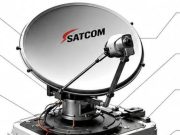
VSAT (Very Small Aperture Terminal) is a satellite communication system that uses a relatively small dish antenna, typically ranging from 0.75 meters to 2.4 meters in diameter, to communicate with a satellite. Unlike traditional large satellite earth stations, VSAT systems are compact, cost-effective, and easier to install.
A VSAT terminal communicates with a satellite, which relays signals to a central Hub Station or Gateway connected to the internet or private enterprise networks. This allows users in remote locations to exchange data with virtually any location worldwide.
VSAT technology supports both point-to-point and point-to-multipoint communication, making it suitable for individual sites as well as large distributed networks.
Basic Working Principle
The operation of a VSAT system follows a straightforward communication process:
- A user’s computer, router, or local network generates data.
- The data is sent to the VSAT modem.
- The modem converts digital information into radio frequency (RF) signals.
- The Block Upconverter (BUC) amplifies the RF signal.
- The dish antenna transmits the signal toward a communications satellite.
- The satellite receives the signal and retransmits it to a central hub station or another remote VSAT terminal.
- The hub processes the information and forwards it to the internet or private network.
- Incoming data follows the reverse path back to the remote terminal.
This process enables seamless two-way communication regardless of geographical distance.
Main Components of a VSAT System
A complete VSAT installation consists of several important components.
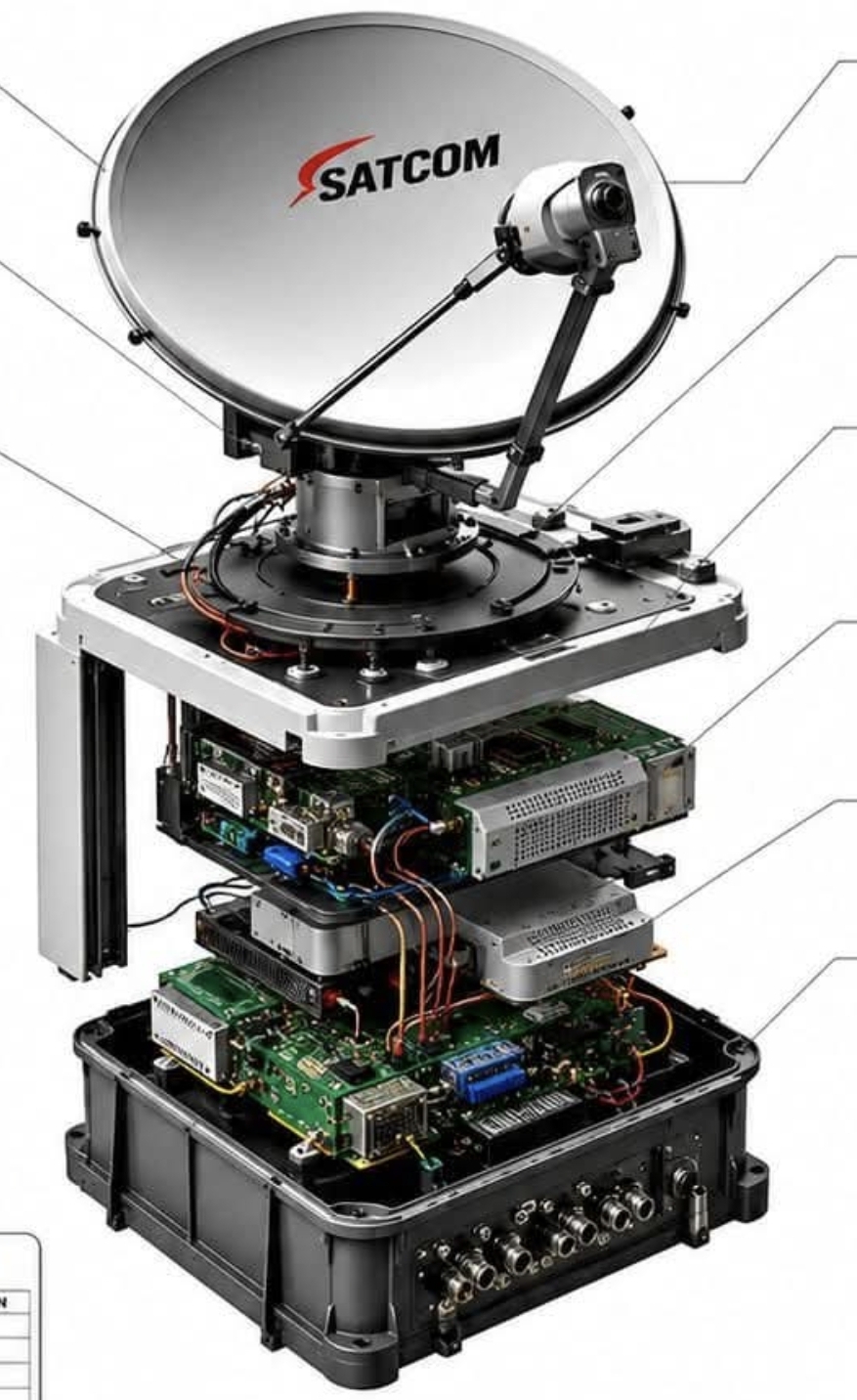
1. Satellite Dish Antenna
The dish antenna focuses transmitted and received microwave signals toward the satellite.
Its functions include:
- Signal transmission
- Signal reception
- RF energy focusing
- Improving antenna gain
The size of the dish depends on:
- Frequency band
- Link budget
- Geographic location
- Service provider requirements
Common dish sizes range from 75 cm to 2.4 meters.
2. Feed Horn
The feed horn is mounted at the focal point of the dish.
Its responsibilities include:
- Collecting received signals
- Feeding transmitted signals into the reflector
- Minimizing signal loss
- Maintaining polarization
The feed horn plays a critical role in efficient antenna performance.
3. Block Upconverter (BUC)
The BUC converts lower-frequency signals generated by the modem into higher microwave frequencies suitable for satellite transmission.
Functions include:
- Frequency conversion
- RF amplification
- Signal transmission
The BUC determines the transmitted power level of the VSAT terminal.
4. Low Noise Block Downconverter (LNB)
The LNB receives weak microwave signals from the satellite.
Its functions include:
- Signal amplification
- Frequency conversion
- Noise reduction
The LNB converts high-frequency satellite signals into lower intermediate frequencies that the modem can process.
5. VSAT Modem
The modem is the central processing unit of the VSAT terminal.
It performs:
- Modulation
- Demodulation
- Error correction
- Traffic management
- Network synchronization
- Encryption support
The modem interfaces with routers, computers, and network switches.
6. Router or Switch
The router distributes internet connectivity to local devices.
Connected equipment may include:
- Computers
- IP phones
- CCTV cameras
- Servers
- Wi-Fi access points
- Industrial controllers
7. Communications Satellite
The satellite acts as a relay station in space.
It receives signals from one earth station and retransmits them to another.
Depending on the system design, satellites may be:
- Geostationary Earth Orbit (GEO)
- Medium Earth Orbit (MEO)
- Low Earth Orbit (LEO)
Traditional VSAT systems primarily use GEO satellites.
8. Hub Station
The hub station serves as the central gateway connecting multiple VSAT terminals.
It manages:
- Authentication
- Traffic routing
- Network management
- Internet connectivity
- Performance monitoring
Large service providers may operate several geographically distributed hubs.
Frequency Bands Used
VSAT systems operate in several microwave frequency bands.
C-Band
- Approximately 4–8 GHz
- Excellent rain resistance
- Common in tropical regions
Ku-Band
- Approximately 12–18 GHz
- Smaller antennas
- Widely used for broadband internet
Ka-Band
- Approximately 26–40 GHz
- Higher bandwidth
- Higher throughput
- More susceptible to rain attenuation
The choice of frequency depends on application requirements and environmental conditions.
Data Transmission Process
When a user opens a webpage, the following sequence occurs:
- The computer sends a request to the router.
- The router forwards the data to the VSAT modem.
- The modem modulates the data.
- The BUC amplifies the RF signal.
- The dish antenna transmits it toward the satellite.
- The satellite relays the signal to the hub.
- The hub retrieves the requested webpage from the internet.
- The response travels back through the satellite.
- The remote VSAT terminal receives the information.
- The webpage appears on the user’s device.
This process happens within fractions of a second.
High-Speed Data Transmission
Modern VSAT systems support significantly higher data rates than earlier generations.
Typical capabilities include:
- Broadband internet
- Voice over IP (VoIP)
- Video conferencing
- Cloud applications
- VPN connectivity
- Real-time monitoring
- File transfer
- CCTV surveillance
- SCADA systems
Depending on the service plan and satellite technology, speeds may range from a few megabits per second to well over 100 Mbps.
Advantages of VSAT
VSAT offers numerous benefits.
Wide Coverage
Connectivity is available almost anywhere with satellite visibility.
Independent Infrastructure
No dependence on fiber or microwave networks.
Rapid Deployment
Installation can be completed relatively quickly.
High Reliability
Satellite links remain operational even when terrestrial infrastructure is unavailable.
Scalability
Additional sites can be added easily.
Disaster Recovery
VSAT provides emergency communications during natural disasters and infrastructure failures.
Secure Communication
Encryption and VPN technologies protect transmitted data.
Limitations of VSAT
Despite its many strengths, VSAT has some limitations.
Higher Latency
Signals travel approximately 36,000 km to geostationary satellites, introducing noticeable delay.
Weather Effects
Heavy rain can weaken microwave signals, particularly in Ku-band and Ka-band systems.
Equipment Cost
Initial installation costs can be higher than terrestrial broadband.
Line of Sight Requirement
The antenna must have an unobstructed view of the satellite.
Buildings, trees, or mountains may block communication.
Applications of VSAT
VSAT technology is used in numerous industries.
Remote Internet Access
Provides broadband connectivity to isolated communities.
Banking
Banks use VSAT to connect remote branches securely to central data centers.
Oil and Gas
Supports offshore platforms, pipelines, and drilling operations.
Mining
Provides communications for remote mining sites.
Maritime Communication
Ships use VSAT for:
- Internet access
- Navigation updates
- Crew welfare
- Operational communications
Aviation
Aircraft operators use satellite systems for operational data and passenger connectivity.
Military
Military organizations depend on VSAT for secure communications in remote deployment areas.
Emergency Services
VSAT enables communications after:
- Earthquakes
- Floods
- Hurricanes
- Wildfires
when terrestrial networks may be damaged.
Education
Remote schools receive internet access for online learning and educational resources.
Healthcare
Hospitals and clinics use VSAT for:
- Telemedicine
- Medical imaging
- Electronic health records
- Remote consultations
VSAT vs Fiber Optic Communication
Both technologies have advantages.
Fiber Optic Networks:
- Extremely high bandwidth
- Very low latency
- High reliability
- Limited to installed infrastructure
VSAT Systems:
- Available in remote locations
- Rapid deployment
- Wide geographic coverage
- Higher latency due to satellite distance
In many cases, organizations use VSAT as a backup connection for critical services.
Best Installation Practices
To ensure reliable VSAT performance:
- Install the dish with a clear view of the satellite.
- Align the antenna accurately using signal strength measurements.
- Secure all mounting hardware against wind.
- Use high-quality RF cables and connectors.
- Properly ground equipment for lightning protection.
- Regularly inspect and clean the antenna.
- Monitor signal quality and modem alarms.
Following these practices improves system reliability and service availability.
Future of VSAT Technology
Satellite communications continue to evolve rapidly. New generations of high-throughput satellites (HTS) and non-geostationary satellite constellations are delivering greater capacity, lower latency, and improved global coverage. Advances in adaptive coding, modulation, beamforming, and network management are enabling VSAT systems to support cloud computing, Internet of Things (IoT) deployments, remote industrial automation, and broadband services with higher efficiency. As demand for connectivity grows in underserved regions, VSAT will remain an important technology for extending digital access and supporting mission-critical communications.
Conclusion
The VSAT (Very Small Aperture Terminal) satellite communication system is a powerful and versatile technology designed to provide reliable internet and data connectivity in locations where terrestrial communication infrastructure is unavailable or impractical. Using a compact satellite dish, a VSAT modem, a Block Upconverter (BUC), a Low Noise Block Downconverter (LNB), and a communications satellite, the system enables secure two-way transmission of voice, video, and data over vast distances. Modern VSAT systems support high-speed broadband services and operate in frequency bands such as C-band, Ku-band, and Ka-band, offering flexibility for different applications and environments. Their wide coverage, rapid deployment, scalability, and independence from ground-based infrastructure make them invaluable for remote internet access, banking, healthcare, education, oil and gas, mining, maritime operations, emergency response, and military communications. Although factors such as latency and weather can affect performance, continuous technological improvements are enhancing the speed, reliability, and efficiency of satellite communications. As global demand for connectivity continues to increase, VSAT technology will remain a critical solution for delivering dependable communication services to remote and underserved regions around the world.