


LoRa (Long Range) Wireless Communication Technology: Principles, Architecture, Applications, and Advantages
Introduction
As the Internet of Things (IoT) continues to expand, billions of devices are being connected to the internet to collect, transmit, and analyze data. These devices range from environmental sensors and smart electricity meters to industrial machines, agricultural monitoring systems, asset trackers, and home automation equipment. One of the greatest challenges in IoT is finding a communication technology that can transmit data over long distances while consuming very little power. Traditional wireless technologies such as Wi-Fi and Bluetooth provide high data rates but have relatively short communication ranges and higher power consumption. Cellular technologies like 4G and 5G offer wide-area coverage but require more energy and incur operational costs through network subscriptions.
To address these challenges, LoRa (Long Range) was developed as a low-power, long-range wireless communication technology specifically optimized for IoT applications. LoRa enables small amounts of data to be transmitted over distances of several kilometers while allowing battery-powered devices to operate for years without replacement. Its unique modulation technique provides exceptional sensitivity and resilience against interference, making it suitable for communication in rural areas, urban environments, industrial facilities, forests, and remote locations.
Today, LoRa has become one of the most widely adopted technologies for Low Power Wide Area Networks (LPWANs). It supports countless applications including smart agriculture, environmental monitoring, smart cities, industrial automation, utility metering, logistics, and healthcare.
What Is LoRa?
LoRa, which stands for Long Range, is a proprietary wireless communication technology developed by Cycleo and later acquired by Semtech Corporation. It uses a modulation technique known as Chirp Spread Spectrum (CSS) to transmit data efficiently over long distances while maintaining low power consumption.
Unlike Wi-Fi or Bluetooth, LoRa is not designed to carry large amounts of data such as videos or high-speed internet traffic. Instead, it is optimized for transmitting small packets of information, such as sensor readings, control commands, GPS coordinates, or equipment status updates.
Because of its excellent receiver sensitivity and robust modulation, LoRa can maintain reliable communication even when signal levels are below the noise floor.
Basic Working Principle
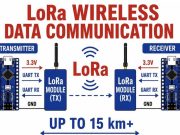
A typical LoRa communication system consists of:
- Microcontroller
- LoRa Transmitter Module
- Antenna
- Wireless Radio Channel
- LoRa Receiver Module
- Receiving Microcontroller
The communication process begins when a microcontroller collects data from connected sensors or devices.
Examples include:
- Temperature
- Humidity
- Soil moisture
- Water level
- GPS location
- Voltage
- Current
- Motion detection
The microcontroller sends this information to the LoRa transmitter through a UART (Universal Asynchronous Receiver/Transmitter) serial interface.
The LoRa transmitter converts the digital information into radio frequency signals using Chirp Spread Spectrum modulation.
The antenna radiates the signal into free space.
At the receiving location, another LoRa module captures the radio signal.
The receiver demodulates the information and sends the recovered digital data to another microcontroller through UART, where it can be displayed, stored, processed, or forwarded to cloud platforms.
System Architecture
A simple LoRa communication link contains several important components.
1. Microcontroller
The microcontroller acts as the system controller.
Popular microcontrollers include:
- Arduino Uno
- Arduino Mega
- ESP32
- ESP8266
- STM32
- Raspberry Pi Pico
Its responsibilities include:
- Reading sensor values
- Formatting data
- Sending serial commands
- Processing received messages
- Power management
2. UART Interface
Communication between the microcontroller and the LoRa module typically occurs using UART.
UART provides simple serial communication using:
- TX (Transmit)
- RX (Receive)
- GND
- Power
The UART interface allows straightforward integration without complex hardware.
3. LoRa Transmitter Module
The transmitter performs several functions:
- Data encoding
- Error correction
- Modulation
- RF amplification
- Signal transmission
Popular LoRa chipsets include:
- SX1276
- SX1278
- SX1262
- SX1268
4. Antenna
The antenna radiates the RF signal.
Communication range depends heavily on:
- Antenna gain
- Antenna quality
- Installation height
- Cable losses
- Polarization
Proper antenna selection significantly improves system performance.
5. Wireless Channel
The transmitted signal propagates through the atmosphere.
Environmental conditions affecting communication include:
- Buildings
- Trees
- Hills
- Rain
- Electromagnetic interference
Despite these challenges, LoRa’s robust modulation enables excellent performance.
6. LoRa Receiver
The receiver captures weak radio signals.
It performs:
- Demodulation
- Error correction
- Packet validation
- Data recovery
Recovered information is forwarded to the receiving microcontroller.
Communication Range
One of LoRa’s greatest strengths is its exceptional communication distance.
Typical ranges include:
- Indoor: 100–500 meters
- Urban: 2–5 km
- Suburban: 5–10 km
- Rural: 10–15 km
- Line-of-Sight (LOS): 15–20 km or more
Some experimental deployments have exceeded 100 km under ideal conditions using elevated antennas and favorable atmospheric conditions.
Actual range depends on:
- Antenna quality
- Frequency
- Transmit power
- Terrain
- Receiver sensitivity
- Obstacles
- Weather
Frequency Bands
LoRa operates within license-free Industrial, Scientific, and Medical (ISM) frequency bands.
Common frequencies include:
- 433 MHz
- 470 MHz
- 868 MHz (Europe)
- 915 MHz (North America)
- 923 MHz (parts of Asia)
These bands allow deployment without purchasing expensive radio spectrum licenses, although local regulations regarding transmit power and duty cycle must be followed.
Chirp Spread Spectrum (CSS)
LoRa’s unique performance comes from Chirp Spread Spectrum modulation.
Instead of transmitting narrowband signals, LoRa spreads information across a wider frequency range using continuously changing frequency chirps.
Advantages include:
- High receiver sensitivity
- Excellent interference resistance
- Long communication distance
- Reliable performance
- Better multipath tolerance
This modulation technique allows successful reception even when signals are weaker than background noise.
Low Power Consumption
One of LoRa’s defining characteristics is its extremely low energy consumption.
A typical LoRa sensor spends most of its time in sleep mode.
The device wakes periodically:
- Read sensor.
- Transmit data.
- Return to sleep.
This operating cycle enables battery lifetimes of:
- 5 years
- 10 years
- More than 15 years
depending on transmission frequency and battery capacity.
Such efficiency makes LoRa ideal for remote installations where replacing batteries is difficult or expensive.
LoRa vs LoRaWAN
Although often confused, LoRa and LoRaWAN are different.
LoRa
Refers to the physical radio technology responsible for wireless transmission.
LoRaWAN
Is the networking protocol built on top of LoRa.
LoRaWAN manages:
- Device authentication
- Security
- Network management
- Routing
- Gateway communication
- Cloud connectivity
Multiple LoRa devices communicate with gateways using LoRaWAN.
Advantages of LoRa
Long Communication Distance
Coverage of several kilometers reduces infrastructure costs.
Low Power Operation
Battery-powered devices can operate for years.
License-Free Operation
Most deployments use ISM bands without spectrum licensing fees.
High Receiver Sensitivity
Weak signals remain detectable over long distances.
Excellent Building Penetration
Lower frequencies provide good indoor coverage.
Cost Effectiveness
LoRa modules are relatively inexpensive.
Scalability
Thousands of devices can communicate through one gateway.
Reliable Communication
Forward Error Correction improves data reliability.
Limitations of LoRa
Despite many strengths, LoRa has limitations.
Low Data Rate
Typical throughput ranges from approximately 0.3 kbps to 50 kbps depending on configuration.
Large files cannot be transmitted efficiently.
Small Packet Size
LoRa is intended for sensor data rather than multimedia traffic.
Higher Latency
Transmission delays may occur due to low data rates and duty-cycle restrictions.
Duty Cycle Restrictions
Many regions limit transmitter airtime to reduce spectrum congestion.
Typical Applications
LoRa has become one of the most versatile wireless technologies.
Smart Agriculture
Farmers monitor:
- Soil moisture
- Temperature
- Humidity
- Livestock
- Irrigation
Remote sensors improve crop productivity while reducing water usage.
Environmental Monitoring
LoRa networks measure:
- Air quality
- Water quality
- Flood levels
- Forest conditions
- Weather stations
These systems often operate for years on battery power.
Smart Cities
Municipalities deploy LoRa for:
- Smart parking
- Street lighting
- Waste management
- Traffic monitoring
- Air pollution measurement
Utility Metering
Electricity, gas, and water meters automatically transmit readings without manual inspection.
Industrial IoT
Factories monitor:
- Machine vibration
- Equipment temperature
- Production status
- Predictive maintenance
LoRa reduces maintenance costs.
Asset Tracking
Logistics companies track:
- Containers
- Vehicles
- Construction equipment
- Shipping pallets
GPS data is transmitted periodically through LoRa.
Home Automation
LoRa connects:
- Security sensors
- Garden irrigation
- Smart lighting
- Environmental sensors
Its long range enables coverage across large properties.
Healthcare
Hospitals use LoRa for:
- Patient monitoring
- Equipment tracking
- Environmental control
Security Features
LoRaWAN incorporates multiple security mechanisms.
These include:
- AES-128 encryption
- Device authentication
- Network authentication
- Integrity protection
- Secure key management
These features protect transmitted data from unauthorized access.
Practical Example
Consider a smart farming project.
A moisture sensor is installed in a field several kilometers from the farmhouse.
Every thirty minutes:
- The sensor measures soil moisture.
- The microcontroller processes the reading.
- Data is sent through UART to the LoRa module.
- The LoRa transmitter broadcasts the packet.
- A gateway located 10 kilometers away receives the transmission.
- The gateway forwards the data to a cloud server.
- The farmer views moisture levels on a smartphone application.
Because the sensor transmits only a few bytes every half hour, a single battery may power the device for many years.
Design Considerations
Engineers designing LoRa systems should consider:
- Antenna placement
- Gateway location
- Line of sight
- Frequency regulations
- Battery capacity
- Transmission interval
- Spreading factor
- Bandwidth
- Coding rate
- Environmental conditions
Proper planning ensures maximum communication reliability.
Future of LoRa
As IoT deployments continue to expand, LoRa is expected to play an increasingly important role in digital transformation. Emerging applications include precision agriculture, smart energy grids, intelligent transportation systems, wildlife conservation, disaster monitoring, and industrial automation. Integration with cloud computing, edge computing, and artificial intelligence enables organizations to analyze data collected by LoRa sensors in real time, improving decision-making and operational efficiency. With continuous improvements in LoRa chipsets, gateways, and network management platforms, the technology will remain a cornerstone of low-power wide-area networking for years to come.
Conclusion
LoRa (Long Range) is a revolutionary wireless communication technology designed to transmit small amounts of data over long distances while consuming very little power. By using Chirp Spread Spectrum (CSS) modulation, LoRa achieves exceptional receiver sensitivity, robust interference resistance, and reliable long-range communication, making it ideal for battery-powered IoT devices. In a typical LoRa system, a microcontroller collects sensor information and sends it to a LoRa transmitter through a UART interface. The transmitter converts the digital data into radio signals, which are transmitted wirelessly to a remote LoRa receiver. The receiver demodulates the signal and forwards the recovered information to another microcontroller for processing or cloud integration. Operating in license-free ISM frequency bands such as 433 MHz, 868 MHz, and 915 MHz, LoRa can achieve communication distances of up to 15 km or more under line-of-sight conditions, depending on antenna quality, terrain, and environmental factors. Its combination of long range, ultra-low power consumption, affordability, and reliable performance has made LoRa one of the most important technologies for modern IoT applications, including smart agriculture, environmental monitoring, industrial automation, smart cities, utility metering, asset tracking, healthcare, and home automation. As the demand for connected devices continues to grow, LoRa will remain a key enabling technology for scalable, energy-efficient, and cost-effective wireless communication networks worldwide.