

Mobile Networks Evolved from 2G to 5G
Mobile communication has transformed dramatically over the past three decades. What began as simple voice communication over second-generation (2G) networks has evolved into intelligent, cloud-based fifth-generation (5G) systems capable of supporting ultra-high-speed broadband, the Internet of Things (IoT), artificial intelligence (AI), autonomous vehicles, smart cities, and industrial automation. Each generation of mobile technology has introduced significant improvements in network architecture, radio technology, data transmission, latency, capacity, and user experience.
One of the most notable aspects of this evolution is the changing architecture of the Radio Access Network (RAN). The relationship between antennas, radio equipment, and baseband processing has shifted from simple centralized designs in 2G to highly distributed and virtualized architectures in 5G. Understanding this evolution helps engineers appreciate how modern mobile networks achieve higher speeds, lower latency, greater flexibility, and more efficient resource utilization.
2G: The Beginning of Digital Mobile Communication
Second-generation (2G) mobile networks marked the transition from analog cellular systems to digital communication. Introduced during the early 1990s, 2G technologies such as GSM (Global System for Mobile Communications) significantly improved voice quality, security, and network capacity compared to first-generation analog systems.
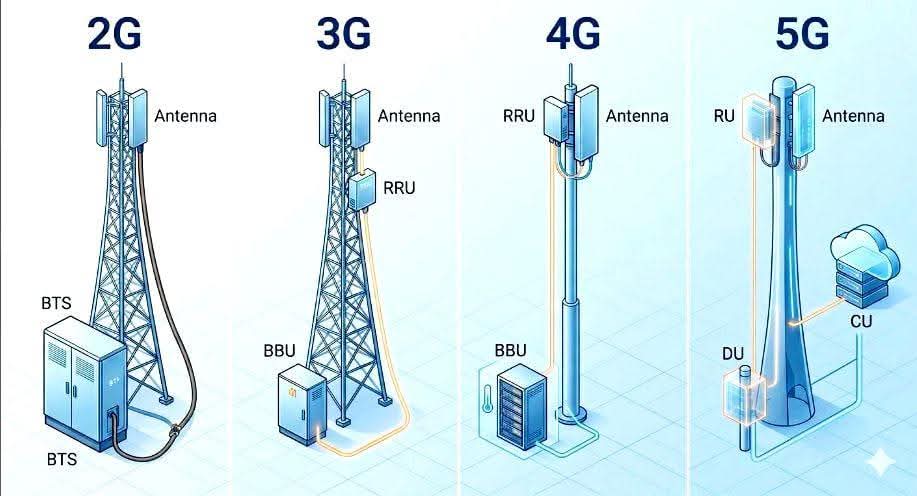
The architecture of a typical 2G base station was relatively simple. The antenna was connected directly to the Base Transceiver Station (BTS), which contained nearly all the radio and signal-processing equipment. Long coaxial feeder cables carried radio frequency (RF) signals between the BTS and the antenna mounted on the tower.
The main components of a 2G site included:
- Antenna
- BTS (Base Transceiver Station)
- Base Station Controller (BSC)
- Mobile Switching Center (MSC)
The BTS generated and received radio signals, while the BSC managed multiple BTS sites by handling functions such as handovers, frequency allocation, and power control.
Although this architecture was straightforward and reliable, it had several limitations. Long feeder cables introduced signal losses, reducing transmission efficiency and requiring higher transmit power. The system was also primarily designed for voice communication and low-speed data services such as SMS and GPRS.
Typical characteristics of 2G networks included:
- Digital voice communication
- SMS messaging
- Low-speed packet data
- Circuit-switched architecture
- Limited internet capability
- Basic antenna configuration
Despite these limitations, 2G revolutionized mobile communication and established the foundation for future generations.
3G: Moving Radio Functions Closer to the Antenna
The introduction of third-generation (3G) networks represented a major advancement in mobile communication. Technologies such as UMTS and WCDMA were designed to support higher data rates, multimedia applications, mobile internet access, and video calling.
One of the most important architectural improvements in 3G was the introduction of the Remote Radio Unit (RRU).
Instead of locating all radio components inside the BTS cabinet at ground level, the RRU was installed much closer to the antenna, often directly behind it on the tower.
This change offered several important benefits.
Reduced Feeder Loss
By placing the RRU near the antenna, long coaxial feeder cables were largely eliminated.
Lower cable losses resulted in:
- Higher transmit efficiency
- Better receiver sensitivity
- Lower power consumption
- Improved overall radio performance
Improved Signal Quality
The shorter RF path reduced attenuation and noise, resulting in stronger transmitted and received signals.
Simplified Installation
Fiber-optic cables replaced many of the heavy coaxial cables, reducing installation complexity and maintenance requirements.
A typical 3G architecture included:
- Antenna
- Remote Radio Unit (RRU)
- Node B
- Radio Network Controller (RNC)
The Node B served as the radio base station, while the RNC managed radio resources, mobility, and handovers.
Although processing remained largely centralized, moving the radio equipment closer to the antenna significantly improved network efficiency.
4G LTE: Centralized Baseband Processing
The arrival of fourth-generation (4G LTE) networks transformed mobile broadband by introducing an all-IP architecture capable of delivering high-speed internet services.
Unlike previous generations, LTE was designed primarily for packet-switched communication.
Video streaming, cloud applications, online gaming, and social media became practical because of dramatically increased network capacity.
The Radio Access Network also underwent major architectural changes.
The key components became:
- Antenna
- Remote Radio Unit (RRU)
- Baseband Unit (BBU)
The RRU remained mounted near the antenna, handling RF transmission and reception.
However, baseband processing became centralized within dedicated BBUs located in equipment shelters or centralized locations.
The BBU performed numerous functions including:
- Digital signal processing
- Scheduling
- Modulation and demodulation
- Coding
- Resource allocation
- Mobility management
Fiber-optic connections using protocols such as CPRI (Common Public Radio Interface) linked the BBU and RRU.
This architecture provided several advantages.
Higher Data Speeds
LTE introduced technologies including:
- OFDMA
- MIMO
- Carrier Aggregation
- Adaptive Modulation
These innovations dramatically increased user throughput.
Better Resource Utilization
Centralized BBUs allowed multiple radio units to share processing resources efficiently.
Lower Operating Costs
Centralization simplified maintenance and reduced equipment duplication.
Easier Network Expansion
Adding additional RRUs required minimal modification to centralized processing equipment.
The 4G era also introduced technologies such as:
- Voice over LTE (VoLTE)
- Self-Organizing Networks (SON)
- Enhanced Inter-Cell Interference Coordination (eICIC)
These improvements significantly enhanced user experience and network efficiency.
5G: A New Cloud-Based Architecture
Fifth-generation mobile networks represent a fundamental redesign of cellular architecture.
Rather than simply increasing data speeds, 5G introduces a flexible, software-driven architecture capable of supporting billions of connected devices and diverse applications.
The traditional base station has been divided into three major functional units:
- Radio Unit (RU)
- Distributed Unit (DU)
- Central Unit (CU)
Radio Unit (RU)
The Radio Unit is installed close to the antenna.
It performs radio frequency functions including:
- RF transmission
- RF reception
- Frequency conversion
- Digital-to-analog conversion
- Analog-to-digital conversion
- Beamforming support
Modern Radio Units often integrate directly with advanced Active Antenna Units (AAUs).
These systems support technologies including:
- Massive MIMO
- Beamforming
- Carrier Aggregation
Distributed Unit (DU)
The Distributed Unit performs time-critical processing functions.
Responsibilities include:
- MAC layer processing
- Scheduling
- Hybrid Automatic Repeat Request (HARQ)
- Radio resource management
- Real-time communication functions
The DU is typically located closer to the radio site to minimize latency.
Central Unit (CU)
The Central Unit performs higher-layer processing.
Typical responsibilities include:
- Mobility management
- Session management
- Packet processing
- Security functions
- Network optimization
Unlike earlier generations, the CU can operate inside centralized data centers or cloud environments.
This cloud-native design provides exceptional flexibility.
Virtualization and Cloud Computing
One of the defining features of 5G is virtualization.
Traditional hardware appliances are increasingly replaced by software running on commercial servers.
This approach offers several advantages:
- Lower equipment costs
- Faster deployment
- Simplified upgrades
- Dynamic resource allocation
- Better scalability
Cloud-native network functions can be expanded or modified without replacing physical hardware.
Massive MIMO and Beamforming
5G introduces Massive Multiple Input Multiple Output (Massive MIMO), where dozens or even hundreds of antenna elements operate simultaneously.
Instead of broadcasting signals equally in every direction, beamforming electronically directs radio energy toward individual users.
Benefits include:
- Increased capacity
- Improved signal quality
- Reduced interference
- Better indoor coverage
- Higher spectral efficiency
These technologies enable operators to serve many users simultaneously while maintaining high data rates.
Open RAN
Modern 5G networks increasingly adopt Open Radio Access Network (Open RAN) principles.
Traditionally, operators purchased complete radio systems from a single vendor.
Open RAN separates hardware and software using standardized interfaces.
Advantages include:
- Multi-vendor interoperability
- Reduced deployment costs
- Faster innovation
- Increased competition
- Greater flexibility
This architecture allows network operators to select equipment from different manufacturers while maintaining compatibility.
Network Slicing
Unlike earlier mobile generations, 5G supports network slicing.
A single physical infrastructure can create multiple virtual networks optimized for different applications.
Examples include:
- Consumer broadband
- Industrial automation
- Emergency services
- Smart transportation
- Healthcare
Each slice receives customized performance characteristics.
Edge Computing
Many 5G services require extremely low latency.
To reduce communication delays, computing resources are placed near users through edge computing.
Applications benefiting from edge computing include:
- Autonomous vehicles
- Augmented reality
- Virtual reality
- Industrial robotics
- Remote surgery
Processing data closer to users significantly improves response times.
Comparison of Mobile Network Evolution
The architectural progression from 2G to 5G demonstrates increasing intelligence and flexibility.
2G
- Antenna connected directly to BTS
- Voice-focused services
- Simple centralized architecture
- Limited data capability
3G
- Introduction of Remote Radio Unit
- Better radio efficiency
- Improved multimedia support
- Higher data speeds
4G LTE
- Centralized Baseband Unit
- High-speed mobile broadband
- All-IP architecture
- Advanced MIMO technologies
5G
- Radio Unit, Distributed Unit, and Central Unit
- Cloud-native architecture
- Massive MIMO
- Beamforming
- Artificial intelligence integration
- Ultra-low latency
- Network slicing
- Edge computing
Future Toward 6G
Although 5G deployment continues worldwide, research on sixth-generation (6G) networks has already begun.
Expected features include:
- Artificial intelligence as a native network function
- Terahertz communication
- Integrated sensing and communication
- Holographic communication
- Digital twins
- Intelligent surfaces
- Space-air-ground integrated networks
These innovations will continue the architectural trend toward greater intelligence, virtualization, and automation.
Conclusion
The evolution of mobile networks from 2G to 5G illustrates the remarkable progress of wireless communication technology. In 2G, the antenna was connected directly to the Base Transceiver Station (BTS), creating a simple architecture primarily designed for voice communication. 3G introduced the Remote Radio Unit (RRU), moving radio functions closer to the antenna to reduce feeder losses and improve signal quality. With 4G LTE, processing became more centralized through the Baseband Unit (BBU), enabling high-speed broadband services, improved spectral efficiency, and widespread mobile internet access. Today, 5G employs a highly flexible architecture divided into the Radio Unit (RU), Distributed Unit (DU), and Central Unit (CU), many of which operate in virtualized cloud environments. Combined with technologies such as Massive MIMO, beamforming, Open RAN, network slicing, and edge computing, this architecture delivers unprecedented capacity, speed, reliability, and scalability. As the telecommunications industry continues to innovate, the transition from 2G to 5G serves as a clear demonstration of how mobile networks have evolved from simple voice systems into intelligent digital platforms capable of supporting the connected world of the future.